Updated: August 19, 2026. This guide is for brands, packaging buyers, designers, and importers comparing custom inserts for folding cartons, rigid boxes, corrugated shipping cartons, gift sets, electronics, cosmetics, and other products. A material name is only a starting point: the finished insert still needs to be tested with the actual product, box, and distribution route.
An insert can hold a product in a repeatable position, separate accessories, stop movement, spread impact, protect corners, guide the packing process, and shape the first impression when the box is opened. These jobs can conflict with one another. A very soft insert may protect a product but slow down packing. A rigid divider may look neat but transfer impact to a fragile corner. A recyclable-looking material may still become difficult to separate after lamination or adhesive is added.
Start the discussion with the product and the risk, then choose the insert. If a supplier starts by recommending a material without asking for product dimensions, weight, photos, quantity, and shipping conditions, the design brief is not complete yet.
| Insert material | Typical protection | Presentation | Tooling and volume | Good starting point for |
|---|---|---|---|---|
| Paperboard | Light to medium positioning and separation | Clean, printable, easy to brand | Low tooling; useful for small and medium runs | Cosmetics, cards, small electronics, gifts |
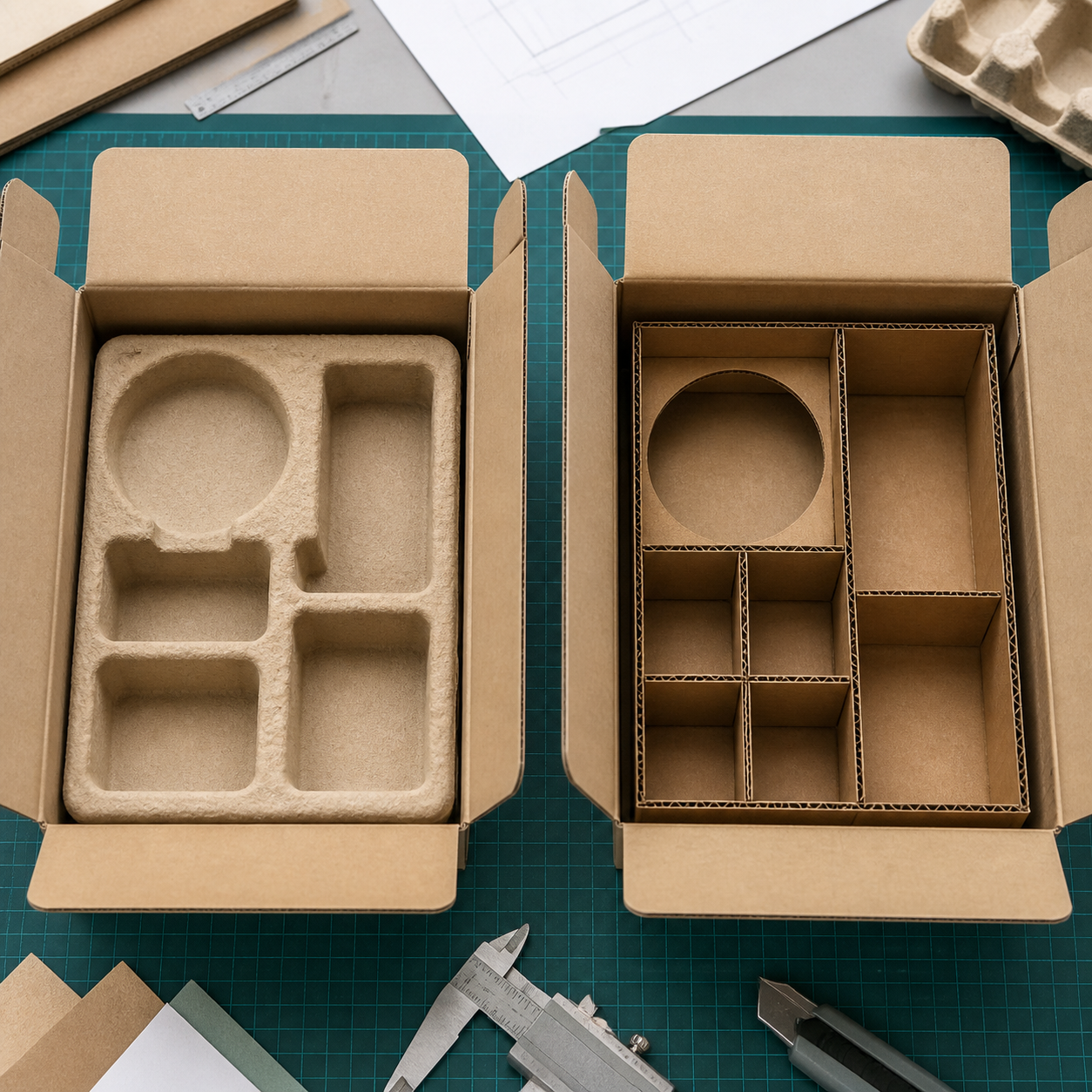
| Corrugated board | Medium to high separation and transport support | Functional; can be covered or printed | Low tooling; easy to prototype and revise | E-commerce, appliances, hardware, shipping cartons |
| Molded pulp | Medium to high positioning and cushioning | Natural fiber appearance; can be shaped closely | Dedicated tooling; usually better for medium or high volume | Electronics, bottles, appliances, fiber-based gift packaging |
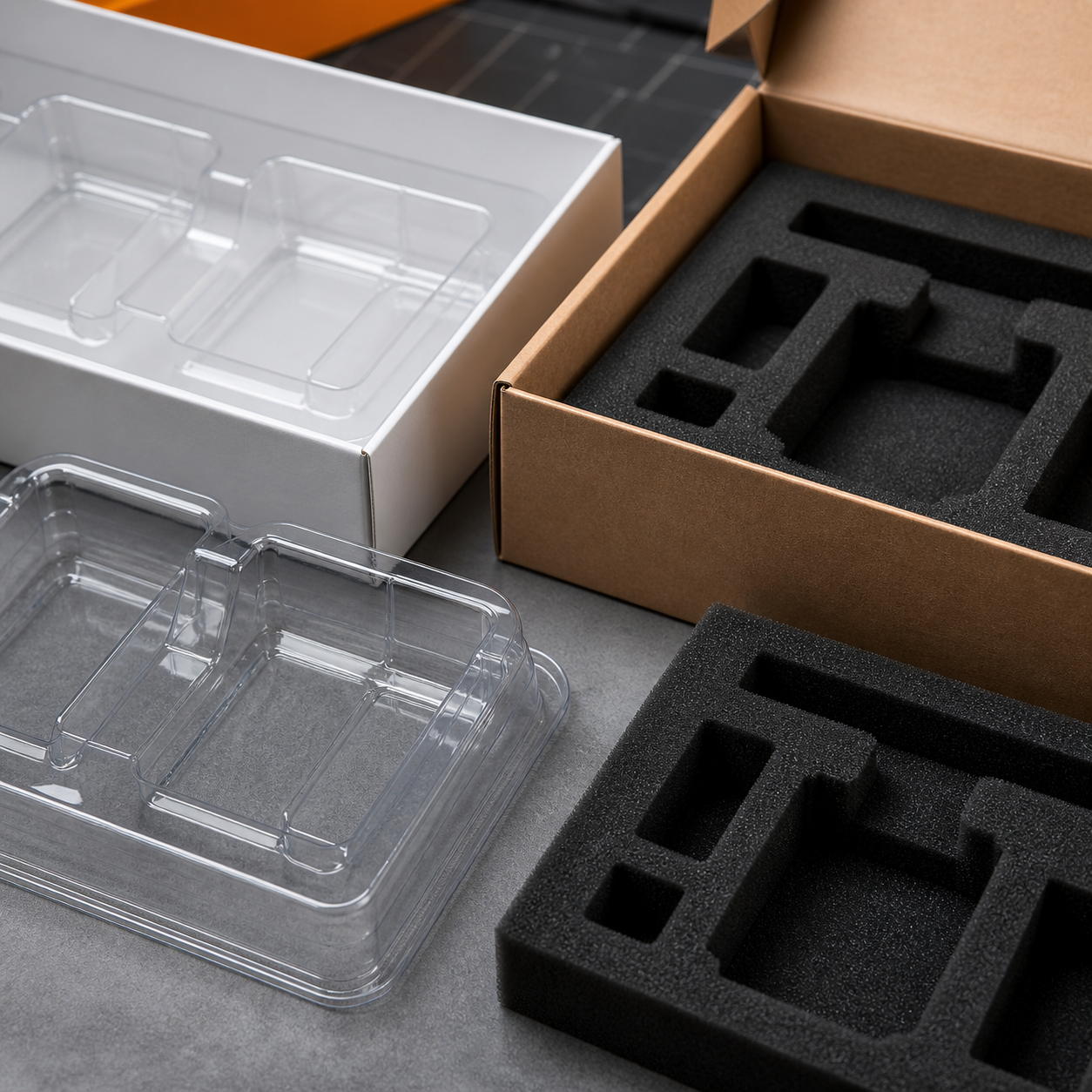
| EVA foam | High retention and impact cushioning | Precise and premium; can be covered | Cutting or CNC methods vary with volume and complexity | Jewelry, watches, instruments, luxury electronics |
| PET tray | Accurate positioning and compartment control | Clear, visible, consistent | Thermoforming tooling; usually stronger at higher volume | Retail sets, cosmetics, accessories, automated packing |
Paperboard inserts are made by die-cutting, creasing, folding, and sometimes locking or gluing paperboard into platforms, dividers, sleeves, pockets, or product-holding structures. They can sit inside folding cartons, rigid boxes, gift boxes, and small mailers.
Paperboard is often a good first option for cosmetic bottles, skincare sets, cards, chargers, cables, stationery, promotional gifts, confectionery packaging, and other relatively light products that need organization more than shock absorption.
Paperboard does not absorb impact like foam, and a thin support can buckle under a heavy product. Board thickness, grain direction, locking tabs, contact points, and load-bearing panels need to be designed around the actual product. A paperboard insert that works for a 100-gram bottle may fail when used for a heavy appliance component.
Corrugated inserts use fluted board for separation, cushioning, and structural support. They can be designed as dividers, end caps, sleeves, suspension elements, or layered supports inside a shipping carton.
Typical applications include consumer electronics, home appliances, hardware, tools, glass containers, e-commerce products, furniture components, and industrial parts. If transport protection matters more than a luxury interior finish, corrugated is often the most practical place to start.
Exposed flutes and edges may not give the refined look expected in a premium gift box. The insert can be covered, printed, or combined with paperboard when appearance matters. Design the support around the product’s center of gravity and likely impact directions, then connect the insert review with the ECT, BCT, and corrugated stacking-strength guide.
Molded pulp, also called molded fiber, is formed into a three-dimensional tray or protective structure. It can follow a product’s shape closely and is often considered when a brand wants a fiber-based alternative to a plastic tray or foam insert.
Molded pulp normally needs dedicated tooling, so it may be less economical for a very small order. Development can also take longer than a simple die-cut insert. Wall thickness, draft angle, cavity depth, moisture exposure, surface texture, and dimensional tolerance need to be checked with the actual product, not only from a drawing.
Do not use the word “sustainable” as a substitute for a material assessment. Coatings, inks, labels, adhesives, contamination, and local collection systems can all change the end-of-life result.
EVA is a closed-cell foam that can be die-cut, CNC-cut, laminated, or covered with paper, fabric, or velvet. It is often chosen when a product needs strong retention, a precise cavity, and a premium presentation.
EVA may not suit a paper-only or mono-material packaging plan. Covers, adhesives, and fabric layers can make separation harder. Ask whether the foam density, cavity dimensions, surface cover, odor, and product-contact requirements are appropriate for the application.
PET inserts are normally thermoformed into clear, translucent, or colored trays. They provide consistent cavities and let a customer see the product or accessories without removing the tray.
Thermoforming requires a dedicated tool and is usually easier to justify at higher volume. Deep cavities, sharp corners, and tight tolerances can make the tool and production more complex. PET recyclability also depends on tray design, labels, adhesives, additives, color, and the recycling infrastructure in the destination market. The resin name alone is not a complete sustainability claim.
Fragile glass, electronics, precision parts, and products with protruding components usually need more control than garments, cards, or lightweight accessories. Ask where the product is most vulnerable and what happens if the package is dropped on a corner, face, or edge.
The insert must carry the product without collapsing, but it should not create a hard pressure point. Record product weight, contact area, center of gravity, surface sensitivity, and whether accessories sit in the same compartment.
A cavity that holds a product securely can still be a bad design if the user cannot remove it without a tool, if fingers damage the product, or if the packing team needs too many steps. Include finger notches, pull tabs, loading direction, cable channels, and accessory storage in the first sample.
Luxury packaging may prioritize alignment, hidden supports, soft-touch surfaces, and a clean reveal. E-commerce packaging may prioritize cushioning, low weight, and fast packing. Corrugated, paperboard, molded pulp, EVA, and PET can sometimes be combined, but each extra layer adds cost, assembly time, and end-of-life questions.
Paperboard and corrugated are usually easier starting points for prototypes and smaller runs. Molded pulp and thermoformed PET need dedicated tools and become more commercially attractive when volume justifies the investment. EVA can suit different order sizes depending on whether it is die-cut, CNC-cut, or laminated.
| Product type | Starting materials to compare | Reason to compare them |
|---|---|---|
| Jewelry or watch | EVA or covered paperboard | Precise positioning and premium presentation |
| Cosmetic bottle set | Paperboard, molded pulp, or PET | Compartments, product visibility, and presentation |
| Small electronic device | Molded pulp, EVA, or corrugated | Cushioning, accessory organization, and movement control |
| Large appliance component | Corrugated insert | Load support and parcel transport protection |
| Fiber-based gift set | Paperboard or molded pulp | Paper-based appearance and organized presentation |
| Transparent retail set | PET tray | Product visibility and consistent compartments |
| Hardware or tools | Corrugated or EVA | Support for weight, impact, and repeated handling |
A good insert is more than a cavity that matches a product drawing. Confirm these details before approving the sample:
For a complex or fragile product, provide an actual product sample, an accurate technical drawing, or a 3D file. A supplier cannot reliably design a tight cavity from a product name alone.
An insert should be tested inside the real outer box with the real product. A tray or divider that looks correct on a table may fail when the lid presses down, the product shifts, the box is stacked, or the package is handled by a parcel network.
Start with a structural sample to check fit, loading, removal, and movement. Add a printed sample when artwork, instructions, barcode position, or unboxing appearance matters. For a high-value or high-volume project, keep a production reference with the agreed material and finish. The dummy, digital proof, and production sample guide explains what each stage can and cannot confirm.
If the package also uses a first-open feature, connect the insert review with the paper tamper-evident structure guide. If the insert or box will be loaded by a machine, include box-mouth clearance and jam risk; the automatic cartoning and folding-carton tolerance guide is a useful follow-up.
For the artwork, dieline, barcode, and file side of the project, use the packaging artwork and prepress checklist. For a handoff sheet covering product information and sampling files, see the carton sampling materials and dieline checklist.
There is no universal answer. EVA can provide strong cushioning and precise retention, while molded pulp and engineered corrugated structures can also protect fragile products effectively. The correct choice depends on product weight, shape, contact points, and shipping conditions.
Paperboard, corrugated board, and molded pulp are useful starting points for a fiber-based program. Final recyclability still depends on coatings, adhesives, laminations, labels, contamination, and local collection systems. Protection performance also matters because a product damaged in transit creates additional waste.
Molded pulp may suit a fiber-based appearance and higher-volume program. EVA may provide more precise cavities, stronger cushioning, and a more controlled luxury presentation. Compare the actual product, volume, finish, tooling, and end-of-life requirements rather than choosing by material label alone.
Paperboard and corrugated inserts can carry logos, instructions, and brand colors. Molded pulp can include molded details or selected surface treatments, while EVA and PET branding options depend on the surface and process. Confirm readability after folding, forming, or cutting.
They can. Paperboard and corrugated inserts usually offer easier entry for sampling and smaller runs. Molded pulp and thermoformed PET require dedicated tools and may be more economical at higher volume. EVA costs depend on the cutting method, density, cover, and cavity complexity.
Provide product length, width, height, weight, photos or drawings, fragile areas, accessory list, box style, target quantity, destination market, shipping route, preferred insert material, finish, and testing requirement. An actual product sample is recommended for complex or fragile items. The custom-carton quotation cost breakdown explains why these details affect the final quote.
Send the product dimensions, weight, quantity, box style, distribution route, and the main risk you want the insert to solve. Boya can compare paperboard, corrugated, molded pulp, EVA, and PET options, then develop the box-and-insert structure and sample plan together.
The most useful request is specific: explain whether the priority is impact protection, product visibility, premium presentation, paper-based materials, fast packing, or a lower tooling cost. That gives the packaging team a clear starting point for the design and quotation.
18824998869
公众号